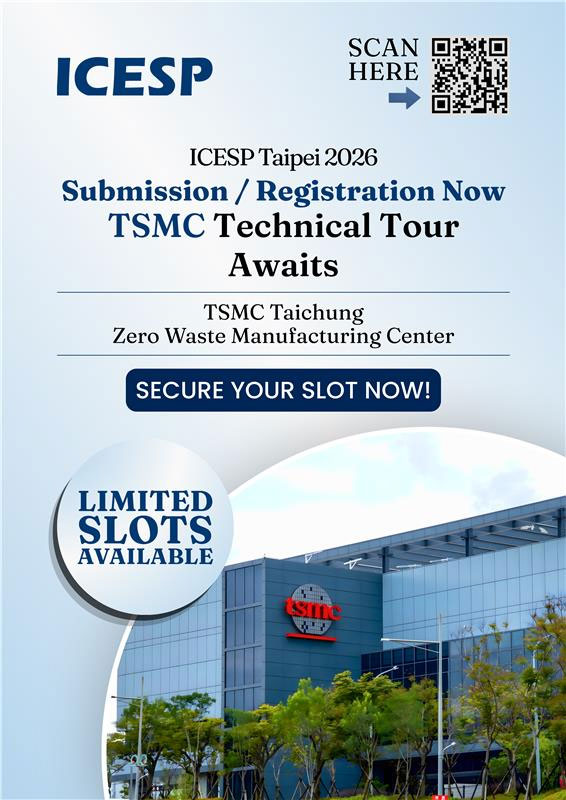
Newsletter
ICESP Taipei 2026 Newsletter
The International Conference on Electrostatic Precipitation (ICESP) is a leading global forum dedicated to advancing electrostatic precipitation and plasma technologies, supported by the International Society for Electrostatic Precipitation (ISESP) and held biennially in countries around the world.
For over four decades, ICESP has served as a vital platform for researchers, industry leaders, and environmental professionals to exchange knowledge, share innovations, and explore the latest developments in electrostatic precipitation and plasma applications. Through this collaboration, ICESP has helped drive progress in cleaner air technologies and strengthen the global network between academia and industry.
In 2026, ICESP will be held for the first time in Taipei, marking a significant milestone in the conference’s history. The event will bring together experts and organizations from across the world to share insights, showcase new technologies, and shape the future of electrostatic precipitation, plasma, and clean air solutions.
Stay tuned for more updates on ICESP Taipei 2026! We warmly welcome your participation and look forward to seeing you in Taipei.
#1 An Invitation To: ICESP Taipei 2026
On behalf of the organizing committee, I am pleased to announce the 18th International Conference on Electrostatic Precipitation (ICESP Taipei 2026), to be held for the first time in Taipei, Taiwan from Nov 2-5, 2026, organized by:
- Graduate Institute of Environmental Engineering, National Taiwan University
- Taiwan Association for Aerosol Research (TAAR)
With support from the
- International Society for Electrostatic Precipitator (ISESP)
Under the theme “Next Decade of ESP in the Transition to Net Zero”, ICESP Taipei 2026 will bring together global experts to share the latest advances in electrostatic precipitation technologies for air pollution control and air quality improvement. We warmly invite you to join us for this exciting event.

#2 ICESP Wishing you a Merry Christmas
Dear Colleagues,
Wishing you a Merry Christmas and a Happy New Year. We look forward to welcoming you to ICESP Taipei 2026 and hope to see you in Taipei next year.
Warm regards,
ICESP Taipei 2026 Organizing Committee

#3 Calling for Abstract - Next Decade of ESP in the Transition to Net Zero
Abstract submissions are now open, until 1 April 2026.
Topics include:
- ESP Fundamentals & Applications
- ESP Operation & Maintenance
- Diverse Industrial Experience in Non-Ferrous, Pulp & Paper, Utility, Mineral Processing, Biomass etc.
- New ESP Improvement Technology
- HV Power Supplies & Advancements
- Semi-conductor Industry: WESP & Non-Thermal Plasma
- Carbon Footprint & Net-Zero Emissions
- Indoor Air Quality & Clean Room Technology
- Non-Thermal Plasma Research & Application
- WESP Technology
- Bag Filter
#4 Speaker Confirmed
Announcement of the Plenary Speaker.
Dr. Jungho Hwang
Department of Mechanical Engineering, Yonsei University, Korea
Dr. Jungho Hwang earned his Ph.D. degree from the Department of Mechanical Engineering at U.C. Berkeley in 1991, after receiving his M.S and B.S. from the Department of Mechanical Engineering at Seoul National University in 1985 and 1983, respectively. He was an Assistant/Associate/Professor in the Department of Mechanical Engineering at Yonsei University between March 1993 and Feb. 2026 and is currently a Professor Emeritus in the same department since March 2026. He has been a member of The Korean Academy of Science and Technology (KAST) and was the President of Korean Association for Particle and Aerosol Research (KAPAR). He served as Editor of Aerosol and Air Quality (AAQR) Journal. His research interests include a variety of aerosol technologies such as fabrication and deposition control of functional nanoparticles, real-time detection and inactivation of bioaerosols. He is also interested in non-thermal plasma technologies for air cleaning and fuel reforming.
Abstract title: Electrostatic precipitation of airborne pathogens: efforts for efficient sampling from the air.
#5 Speaker Two Introduction
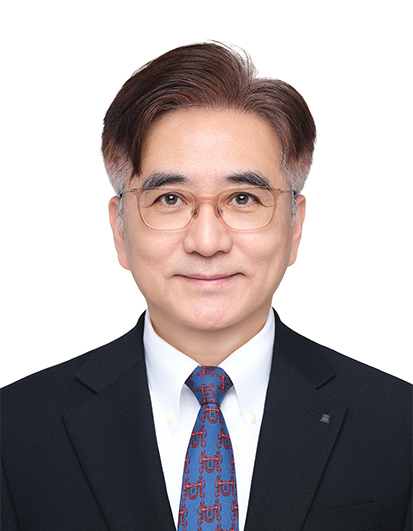
Announcement of the Plenary Speaker Two.
Dr. Moo-Been Chang
Graduate Institute of Environmental Engineering, National Central University
Dr. Moo Been Chang received his M.S. and Ph.D. degrees from the University of Illinois at Urbana–Champaign. He serves as Chair Professor at the Graduate Institute of Environmental Engineering, National Central University, Taiwan. He was the Coordinator of the Department of Environmental Engineering at the National Science Council (2007–2010) and Director of the Taiwan Association for Aerosol Research (2016–2018). Dr. Chang has received several honors, including the Academic Outstanding Research Award from Taiwan’s Ministry of Science and Technology and the Engineering Medal from the Chinese Institute of Environmental Engineering. His research focuses on air pollution control technologies, atmospheric chemistry, persistent organic pollutants (POPs), and non-thermal plasma applications.
Abstract: Next-Generation Air Pollution Control Technology: Integration of ESP-Plasma with Catalysis.
Industrial air pollution has evolved from predominantly particulate matter (PM) emissions toward complex mixtures containing NOx, SOx, volatile organic compounds (VOCs), toxic organic pollutants, and greenhouse gases (GHGs). While conventional air pollution control devices (APCDs) effectively remove particulate and acid gases, modern emission streams present multi-pollutant challenges that exceed the capabilities of single-function...Read more.
#6 Submission Deadline Extension
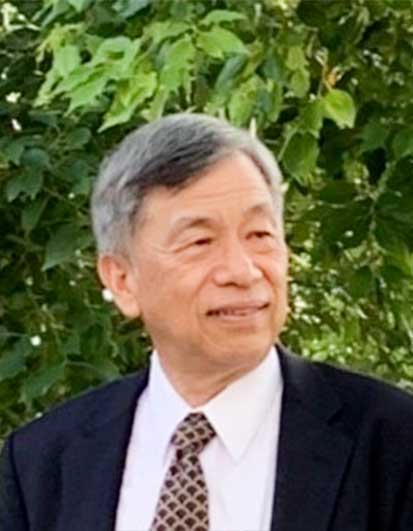
Submission Deadline Extension
Good news! We’ve heard your requests and have extended the abstract submission deadline to give you more time to polish your work. You now have until April 30, 2026 to submit your research and join the conversation at ICESP Taipei 2026. Deadline Extended to: April 30, 2026
#7 Speaker Three Introduction
Announcement of the Plenary Speaker Three.
Dr. Akira Mizuno
Prof. Emeritus, Toyohashi University of Technology
Dr. Akira Mizuno is a Professor Emeritus at Toyohashi University of Technology, Japan. He received his Ph.D. in Electrical Engineering from the University of Tokyo in 1978. He began his career at Ishikawajima-Harima Heavy Industries Co., Ltd., and joined Toyohashi University of Technology in 1981. Dr. Mizuno has made significant contributions to the fields of non-thermal plasma and applied electrostatics. He was among the pioneers in applying non-thermal plasma combined with catalysts for environmental remediation, including the removal of gaseous pollutants from indoor air and NOₓ reduction for diesel exhaust applications. His research interests span a wide range of topics, including particle charging by electron beams, electrostatic precipitation of fine particles, diesel exhaust treatment, gas conversion, heavy oil cracking, sterilization of biological particles using non-thermal plasma, and the manipulation of individual cells and DNA molecules. Dr. Mizuno is an IEEE Life Fellow and a former President of the Institute of Electrostatics Japan.
Abstract: Technological Trajectories in Electrostatic Precipitation: Mitigation of High-Resistivity Particulate Phenomena and Advancement of Non-Thermal Plasma Applications.
Electrostatic precipitation (ESP) has long been a core technology for controlling industrial particulate emissions. The International Conference on Electrostatic Precipitation (ICESP) has played a central role in disseminating knowledge and addressing persistent physicochemical and operational challenges. Major technological advances include the suppression of back corona discharge during...Read more.
#8 Technical Tour Announced
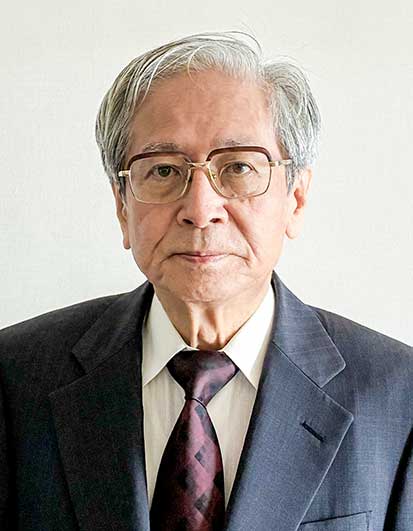
Technical Tour Announced.
Ready to see the future of industry up close? Join us for a one-day technical tour of TSMC, the premier environmentally friendly manufacturing facilities in the region. This isn’t just a site visit, it’s a chance to step out of the office and into a community of innovators. Whether you’re a researcher or an industry veteran, you’ll have the space to swap insights, discuss emerging trends, and expand your professional network with the very people driving the sustainability movement forward. Please note that placements will be assigned based on availability rather than individual preference due to strict site capacities. Submit and register now join this exclusive once-in-a-lifetime technical tour of advanced, eco-friendly manufacturing plants to witness industry-leading innovation firsthand.